

"How long will HITRUST take?" is usually the first question a health tech team asks after a hospital or payer requests it. The honest answer is that it depends on which assessment you need, how big your scope is and how ready you are today. This guide walks through each phase, what makes it faster or slower and how to plan without guessing. For hands-on help, see our HITRUST consulting page.
We don't quote fixed months in this guide, on purpose. Any timeline worth relying on comes from a scoping call and a readiness assessment on your actual environment.
How long does HITRUST certification take?
HITRUST certification has no fixed timeline. It depends on the assessment type (e1, i1 or r2), the size of your scope and how ready your controls and evidence already are. The e1 is the lightest and the r2 takes longest, because it covers the most requirements and is tailored to your risk profile.
The three assessments differ in depth and validity:
| Assessment | What it covers | Certification validity | Relative effort |
|---|---|---|---|
| e1 (essentials) | 44 foundational security controls | 1 year | Lowest |
| i1 (implemented) | About 182 control requirements, leading practices | 1 year | Moderate |
| r2 (risk-based) | Tailored to your risk profile, the most comprehensive | 2 years, with an interim assessment | Highest |
Not sure which one you need? Our free HITRUST assessment chooser recommends one from your answers, and HITRUST e1 vs i1 vs r2 explains the differences.
What are the phases of HITRUST certification?
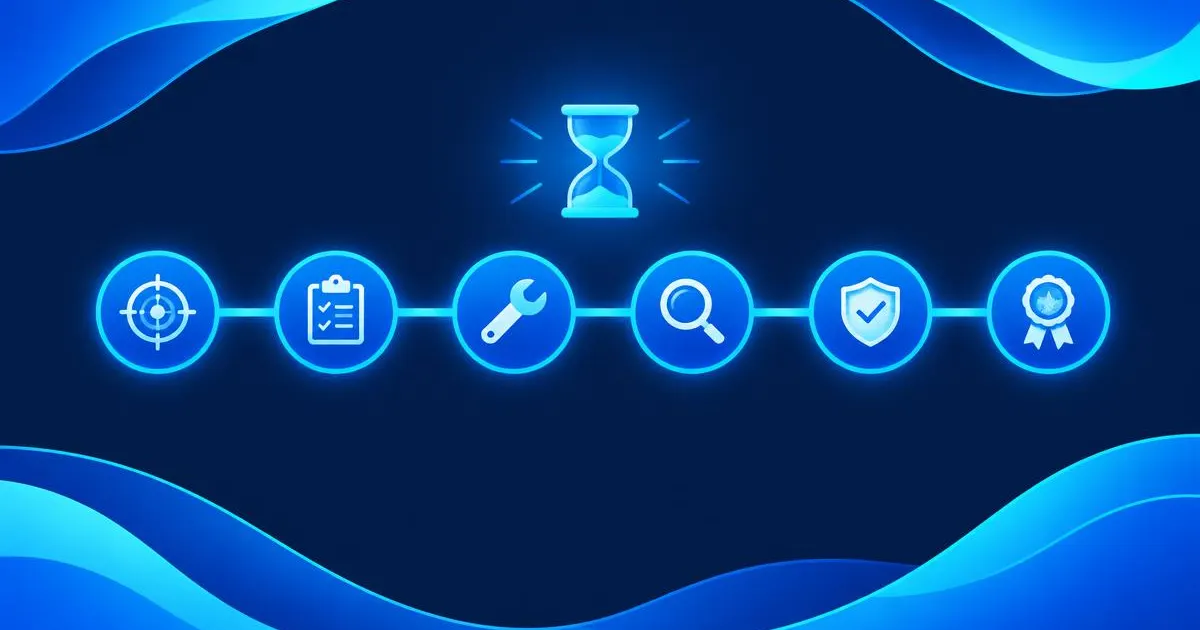
HITRUST certification runs through six phases: scoping, readiness, remediation, the validated assessment, HITRUST quality assurance review and certification. The first three are under your control and usually take most of the time. The last three involve your Authorized External Assessor and HITRUST, so plan for their schedules as well as your own.
1. Scoping
Decide which assessment you need, which systems, locations and teams are in scope, and which cloud services they run on. Ask your customer exactly what they will accept. Scope is the biggest single driver of effort, so time spent here saves time later.
2. Readiness
Compare your current controls and evidence with the HITRUST requirements for your assessment. A HITRUST readiness assessment produces a gap list, which becomes your plan. Work is organized in HITRUST's MyCSF platform; see our MyCSF guide if it's new to you.
3. Remediation
Close the gaps: write or update policies and procedures, implement missing controls and build evidence that they work. Controls need to be operating, not just written down, before the assessment starts.
4. Validated assessment
A HITRUST Authorized External Assessor tests your controls and evidence in MyCSF. Our partner Huduku AI performs validated assessments for CyberWave GRC clients. The assessor's schedule is part of your timeline, so book early.
5. HITRUST quality assurance review
After the assessor submits the assessment, HITRUST reviews it before deciding on certification. Questions from this review go back through your assessor, so keep your team available to answer them.
6. Certification
HITRUST issues the certification. The e1 and i1 are valid for one year; the r2 is valid for two years, with an interim assessment in between.
What affects how long HITRUST takes?
The main factors are the assessment you choose, the size and complexity of your scope, how mature your current controls are, how much evidence already exists, how much you can inherit from your cloud provider, how quickly your team responds and when your assessor is available. Each one can move your timeline more than any other single choice.
- Assessment type. The r2 takes longest; the e1 is the lightest.
- Scope. More systems, locations, products and people mean more to prepare and test.
- Starting maturity. Existing security programs, such as SOC 2 or ISO 27001, cut readiness and remediation time.
- Evidence. Controls that work but aren't documented still need evidence before the assessment.
- Inheritance. Controls inherited from a participating cloud provider don't need to be tested again.
- Team capacity. A named owner with time to work on HITRUST moves faster than a team fitting it around other priorities.
- Assessor availability. Validated assessments are scheduled work, so a late booking can add waiting time.
- Changes mid-project. Changing the assessment type or scope partway through restarts parts of the work.
How can you get HITRUST certified faster?
The most reliable ways to move faster are to start with the right assessment, often an e1, to inherit controls from your cloud provider, to reuse evidence from SOC 2 or ISO 27001, to fix scope early and to book your assessor in good time. None of these cut corners; they remove work you don't need to repeat.
Start with the e1 if your customer accepts it
The e1 covers 44 foundational controls and is designed as a starting point. Work done for it carries into an i1 or r2 later. Before committing, confirm with your customer that an e1 meets their requirement. See HITRUST e1 for startups.
Use cloud inheritance
If you host on AWS, Azure or Google Cloud, HITRUST's Shared Responsibility and Inheritance Program lets you inherit controls from participating providers. HITRUST says that in some cases up to 70% to 85% of requirements can be inherited. Your share depends on your scope. See HITRUST inheritance from AWS, Azure and GCP.
Reuse what you already have
If you hold SOC 2 or ISO 27001, much of your evidence and many of your policies can be reused. Read already have SOC 2? How to use it to get HITRUST faster.
Make decisions once
Agree the assessment type and scope with your customer and assessor before readiness starts. Late changes cause most of the delays we see.
Why does the r2 take longest?
The r2 takes longest because it is the most comprehensive HITRUST assessment. It is tailored to your organization's risk profile, so it usually includes many more requirements than the e1 or i1, and it looks more deeply at how mature your controls are. More requirements mean more evidence to prepare and more for the assessor to test.
It also lasts longer once you have it: two years, with an interim assessment in between. If your customer asks for an r2, plan readiness carefully and use inheritance wherever you can.
What happens after you are certified?
After certification, keep your controls running and your evidence current, because the e1 and i1 must be renewed each year and the r2 needs an interim assessment before its two-year term ends. Treat HITRUST as an ongoing program rather than a one-off project, or the next assessment will feel like starting again.
Practical habits that keep the next cycle shorter:
- Keep evidence in MyCSF up to date as it is produced.
- Review inherited controls when your cloud services change.
- Revisit scope when you launch new products or move systems.
- Decide early whether you will step up from e1 to i1 or r2.
How does CyberWave GRC plan a HITRUST timeline?
CyberWave GRC builds your timeline from a free scoping call and a readiness assessment, not a generic estimate. We handle scoping, gap assessment, remediation guidance, policies, evidence, MyCSF setup and inheritance mapping. Huduku AI, an independent HITRUST Authorized External Assessor, performs the validated assessment, and HITRUST reviews it and issues the certification.
Our fee is fixed after the free scoping call. The HITRUST assessment and HITRUST Alliance fees are quoted separately. For budgeting, see HITRUST certification cost.