

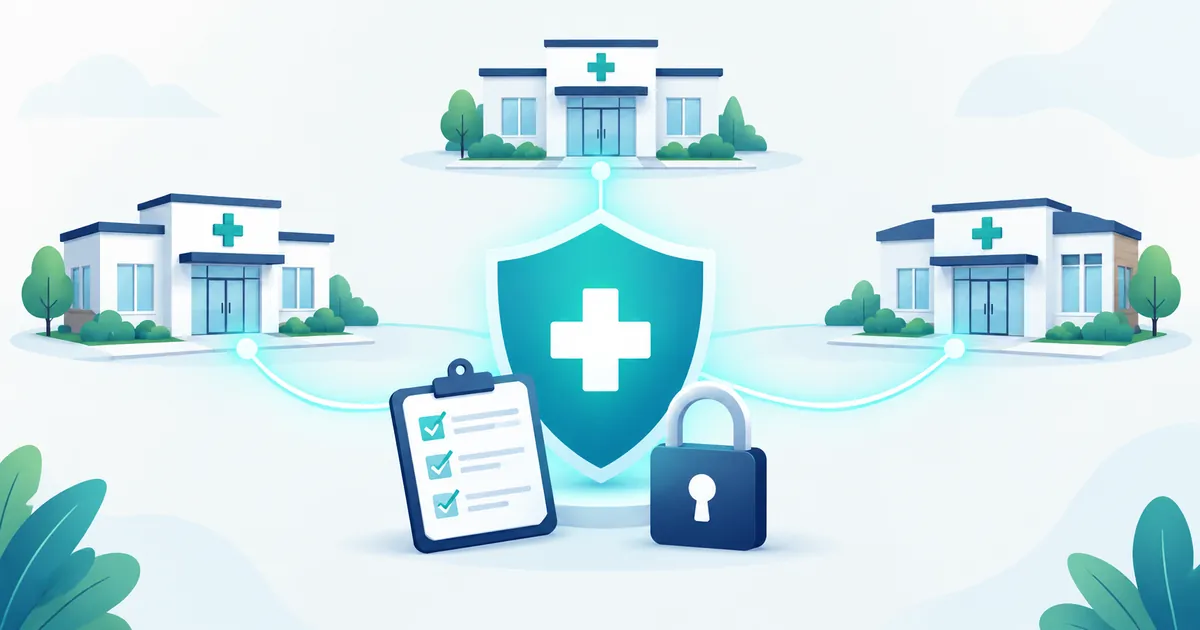
Why multi-location clinics find HIPAA harder
Every new location adds people, devices, front desks, paper records and vendors. Practices that grow by opening or acquiring clinics often end up with different processes at each site, outdated policies and no single owner for compliance. That's exactly what an OCR investigation or a breach exposes.
One program or one per clinic?
| Setup | What HIPAA allows | What it means in practice |
|---|---|---|
| One legal entity, several locations | One covered entity | One set of policies, one risk analysis covering all sites, one Privacy and Security Officer |
| Several legal entities under common ownership | They can designate themselves a single Affiliated Covered Entity (ACE) under 45 CFR 164.105(b) | Shared policies and officers, but the ACE designation must be documented |
| Separate entities with no ACE designation | Each clinic is its own covered entity | Separate documentation for each clinic |
The core requirements, applied across sites
- Security risk analysis (45 CFR 164.308(a)(1)): assess every location, including front-desk computers, imaging equipment, Wi-Fi, paper charts and remote access. The free HHS Security Risk Assessment (SRA) Tool is a useful starting point for small and medium practices, but the analysis must reflect your real environment.
- Privacy and Security Officers (164.530(a) and 164.308(a)(2)): name them in writing. In a group, one person per role is fine, with a contact at each site.
- Policies and procedures: one set, written for how your clinics actually work, approved and reviewed regularly.
- Workforce training: at hire and at least yearly, with attendance records for every location.
- Business Associate Agreements: one register of every vendor that touches patient data (EHR, billing, IT support, answering services, shredding) with a signed BAA for each.
- Notice of Privacy Practices: posted at each location and given to patients.
- Breach response: one process for the whole group, including notifying patients, HHS and, for breaches affecting more than 500 residents of a state or jurisdiction, the media.
Common gaps we see in clinic groups
- A risk analysis done once, years ago, for only the first clinic
- Shared logins at front desks
- No BAA with the IT provider or billing company
- Different training records (or none) at each location
- Old laptops and USB drives with unencrypted patient data
- Personal injury clinics sharing records with law firms without proper authorisations
A practical 90-day plan
- Days 1 to 30: inventory sites, systems and vendors; appoint officers; start the risk analysis.
- Days 31 to 60: finish the risk analysis; write or update policies; collect missing BAAs.
- Days 61 to 90: train all staff; fix the highest risks; set a yearly review calendar.
Track each step with our HIPAA compliance checklist, and see our HIPAA compliance consulting for how we run the full program.