

The short answer
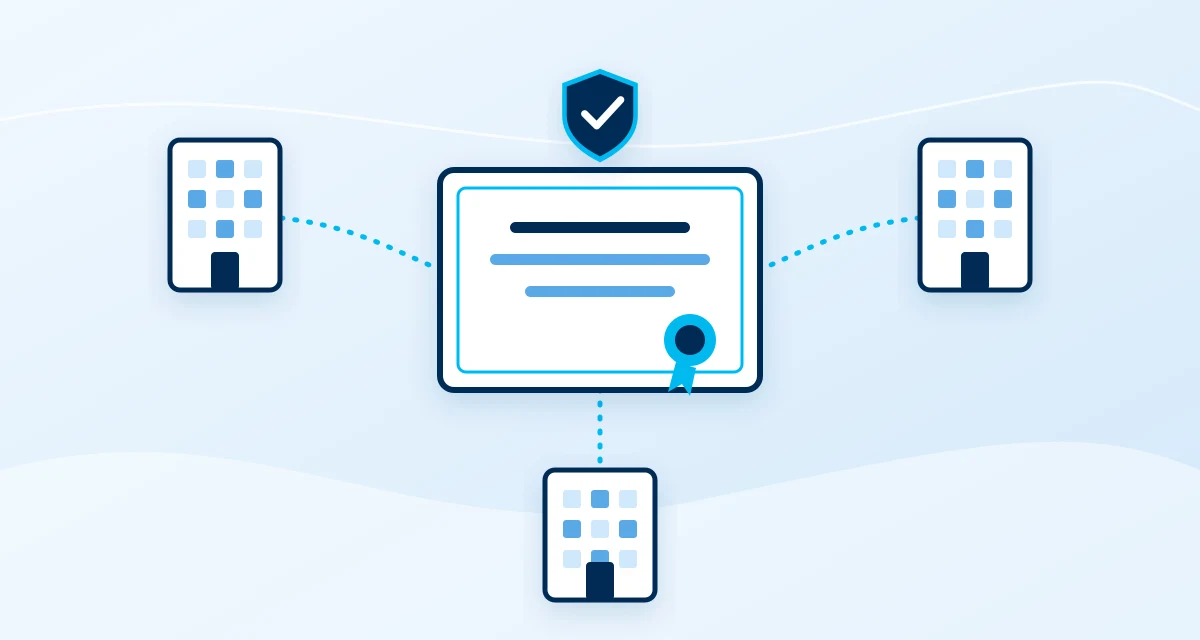
Yes, several companies can share one ISO certificate, but only if they genuinely run as one management system. The certificate then lists each legal entity, and usually each address, under one scope.
This question comes up a lot in India, where a group often has a private limited company that does the work, a US or UAE entity that signs customer contracts, and sometimes a separate company for a second product or a new acquisition.
What the rules say
Accredited certification bodies follow IAF MD 1 for organisations with more than one site or entity. The key points:
- A multi-site organisation doesn't have to be a single legal entity. Sites may belong to the same legal entity or to different ones.
- Every site or entity must have a legal or contractual link with a central function and be covered by one management system.
- The central function must be able to require any site or entity to take corrective action.
- The auditor can visit a sample of sites only where they perform very similar processes. Otherwise every site is audited.
- A major nonconformity at any one site or entity holds up certification for the whole group until it's fixed.
These rules apply in the same way to ISO 27001, ISO 27701 and ISO 9001. Our multi-site certification guide explains how site sampling works.
One certificate or separate certificates?
| Question | One group certificate | Separate certificates |
|---|---|---|
| Shared policies, IT and security or quality team? | Fits well | Duplicates work |
| Audit days | Usually fewer in total, because shared processes are audited once | Each entity audited in full |
| A serious finding in one entity | Holds up the whole group | Affects only that entity |
| Selling or separating one entity later | The certificate scope has to be reduced | Easy |
| Customers who check the supplier's legal name | Each entity is listed on the certificate | Each entity has its own certificate |
| Entities doing very different work | Every entity gets audited, so savings shrink | Simpler |
Questions that decide it
- Do the companies use the same policies, systems, people and IT? If yes, one certificate usually makes sense.
- Which entity signs customer contracts? Its name must appear on the certificate, or customers will ask why their supplier isn't certified.
- Is any entity likely to be sold, spun off or merged soon? Keep it separate.
- Does one entity carry much higher risk, such as a data centre or a health-data business? It may be better audited on its own.
- Are entities already certified with different certification bodies? Moving them under one certificate means one body, so plan the transfer.
Standard-specific points
- ISO 27001. The scope statement and Statement of Applicability must cover every entity, and the risk assessment must include each entity's own risks, such as different offices or local laws.
- ISO 27701. Each entity may act as a controller for some processing and a processor for other processing, and the roles can differ between entities. Record roles per entity, not once for the group.
- ISO 9001. One certificate for related companies is common, for example a manufacturing company and its sister sales company, as long as both work under one quality system.
A phased approach
You don't have to certify everything at once. Many groups certify the main operating company first and add other entities later through a scope extension, which the certification body audits at a surveillance audit or in a separate visit. This spreads the cost and lets newer entities catch up.
What it costs
Audit time depends on headcount, sites and how complex the work is, so one certificate covering everyone is usually cheaper than full separate audits of each company. Ask your certification body to quote both options. For a single company in India, our ISO 27001 fixed fee is ₹4–6 lakh, excluding GST, including the certification body's audit; multi-entity scopes are quoted after a short scoping call.
How CyberWave GRC helps
We map your entities, contracts and shared services, recommend one certificate, separate certificates or a phased route, and agree the plan with your certification body before work starts. Then we build one management system that works across every entity and run internal audits in each of them, so a problem in one company doesn't hold up the rest. If you also need SOC 2, see one SOC 2 report or several.
Our audit-ready guarantee: you will pass. We don't send you into an audit until you're ready for it, and our team has worked on 200+ SOC 1 and SOC 2 engagements plus ISO and HITRUST audits, so we know what auditors test. If the auditor still raises a finding on anything we implemented, we fix it at no extra cost until it's closed and your certificate or clean report is issued.